Blog

After more than 25 years of living, working and playing on Cape Cod we have a lot to share about the area.  Our blog topics run the gamut from fun things to do, working with contractors, and homeownership tips and tricks, so check back frequently to see what's new.  If you have questions or would like to learn more about Cape Cod or owning property on this beautiful peninsula please contact us for more information and to set up a showing for any listing. 

Market Trends and Analysis - Part 3

alt tag

    Our goal in this series is it to help you understand how we interpret markets on the Cape and how this informs our recommendations when developing pricing strategies.  In this installment we will be evaluating a specific market - single family homes on the water, Barnstable to Orleans (Homes on Water Bodies & Homes on Beaches). Immediately we notice some relevant trends.

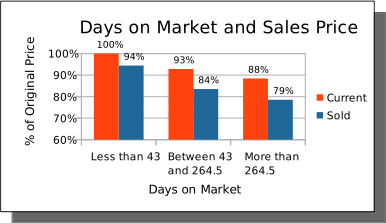
    First the median sales price for these homes is much higher than the Barnstable County median at $1,200,000, yet take far longer to sell with a median days on market of 95 (and an average of 231).  To be fair these are expensive waterfront homes, occupy a smaller market niche, and ultimately take longer to sell.  We also see, based on the bar graph at left, that the group of fastest selling homes (43 days or less) sell for 94% of the asking price - as compared to Brewster in Part 2, those fastest selling homes did so in 25 days or less with 99% of the asking price. 

    Getting back to the waterfront case study, the homes that take longest to sell require price reductions on the order of 12% off the original asking price and only sell for 79% of the original asking price.  What we see here is that people tend to price waterfront homes very aggressively (high) and require significant reductions before they sell.  Furthermore these homes are sold for far less than the original asking price as well as the current asking price - something to think about if you are in the market for a $1,000,000 home on the water.  Consider also that many of these sellers have a price in mind and are willing, can afford, and believe that waiting will get their asking price; however, as is evident in the data, waiting longer does not return a higher sale price.
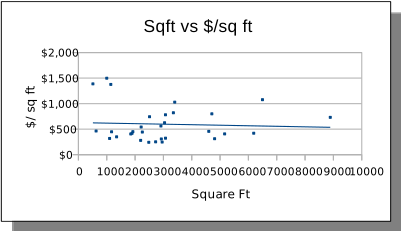
    We discovered one more interesting thing here.  When analyzing certain markets it is useful to know how square footage affects sale price - and it may not be what you think.  In this market (and this is not always the case) the larger the home the fewer dollars per square foot ($/sqft) it returns.  Using the trend line on the graph we would predict that a 9000sqft home would sell for about $500/sqft whereas a 1000sqft home would sell for closer to $600/sqft.  Mind this is a loose relationship but it is a trend that reappears in many markets.  The takeaway?  Larger waterfront homes are having a harder time selling than smaller ones - price reductions may be warranted earlier in developing a sales strategy.

  Check back next time for our final part in the series: some long term analyses.

Market Trends and Analysis - Part 2

alt tag

    Our goal in this series it to help you understand how we interpret markets on the Cape and how this informs our recommendations when developing pricing strategies.  In this installment we will be evaluating a specific market - homes in Brewster between $300k and $500k.  We chose this market because it includes the current median sales price in Barnstable County of $380,000. 

    From August 1, 2017 until October 26th (when we ran the numbers) only 25 homes have sold in this price range in Brewster.  Remarkably, the median sales price is ...$380,000, and the average days on market is 66.  As a result we note that in the past three months houses in Brewster sell more quickly than the average in Barnstable County.  Furthermore Brewster shows signs favoring sellers.  We see this in the fact that homes sell relatively quickly and return a higher % of original list price than Barnstable County overall (please see Part 1 for this graph and explanation).  When looking at the last 3 weeks we also note that fewer price reductions are needed before homes are selling.  Other points of interest that we consider - though don't have time to discuss fully - include absorption rate, total listings and withdrawn listings.

    We look forward to introducing part 3 of this series when we compare markets with specific features (water!).  If you are curious about how your home will compete in your local market please contact us today or click here to get a home valuation.

Market Trends and Analysis - Part 1

alt tag

    We always try to understand the real estate market on Cape Cod in a variety of ways and to explain our understanding to our clients.  For the first installment of this series we will be looking at Barnstable County as a whole and explaining an interesting trend that carries over into many markets on Cape Cod.  Our goal is to help you understand how we interpret the market here on the Cape and how it informs our decisions when developing pricing strategies.

    To begin we found residential property sales from $100,000 to $2,000,000 for the past 365 days and calculated the median days on market and sales price.  In this case median days on market is 55, median sales price is $380,000.  Why median and not average? When describing a set of data that is not normally distributed (a bell curve), average is not necessarily the best way to describe the central tendency of the data.  The median says that 50% of homes that sold were equal to or greater than that price, and the other 50% were less than or equal to that price.  This helps us get a better picture than the average for what a typical house sells for on Cape Cod (since only a few expensive homes will pull this average up).  Also for the days on market the same discrepancy is apparent: median is 55 days, average 100 days.  The average in this case is skewed above what is typical because some houses take a very long time to sell.  So we stick with median for these cases.

    The other thing we find is that the longer a house stays on the market, the less money it makes...in two ways.  Notice the graph at right.  The pairs of bars represent the fastest selling homes (selling in less than 26 days), the middle (26-118 days) and the slowest selling homes (more than 118 days).  The red bars are the current price as a percent of the original list price.  The blue bars are the sale price as a percent of the original list price. What we see is that the fastest selling houses don't reduce in price (red = 100%) and sell for very near the original asking price (98%).  The next set of homes reduce their current price to 97% of original and sell for only 94% of the original.  The last group reduce the price yet again and sell for even less than the original asking price.  The trend is towards weaker offers generating lower sales prices.

    The lesson is three fold.  First, by pricing your home well from the start you are increasing your chances of getting a better offer.  Second, leaving your home at a high price for too long tends to return lower offers - a principle which is more pronounced the longer your house spends on the market. Finally, by using qualified local real estate agents who understand the local markets you are maximizing your chances of pricing your home correctly from day one.  One final point, agents do not determine the price of your home, the market does.  

    If you are curious about how your home will compete in the local market please contact us today or click here to get a home valuation.


5 Things to Consider When Hiring a Contractor

alt tag

Fall is a great time to consider more significant home improvements including bathroom and kitchen remodeling, exterior residing and shingling, and landscaping upgrades and improvements.  With the holidays still months away many projects can be completed before guests, turkeys, and trees begin occupying your time.  If your project is a more [...]

Things to do in the Fall on Cape Cod

alt tag

Ask Agnes Vol IV: Fall on Cape Cod

Cape Cod Chatelains: "Can you believe, Agnes, that Labor day is almost here and fall is just around the corner?"

Agnes: "Unbelievable.  I love the summer on Cape Cod but fall is fantastic for a lot of different reasons."

CCC: "That certainly makes my next question easy...what do you love about fall Agnes?"

[...]

Add value to your home through exterior improvements

alt tag

  As the days get shorter and the prospect of fall becomes ever more apparent, outdoor landscaping improvements seem less daunting.  Cooler weather makes outdoor projects more enjoyable and undertaking even simple jobs can add significantly to the curb appeal of your home.  The National Association of Realtors published a report relating to [...]

Cape Cod Open Houses August 12th and 13th

alt tag


We have three excellent open houses this weekend as well as numerous others throughout the Cape.  We are featuring the wonderful property on 9 Osborn Snow Drive, East Dennis.  From the fruit orchard, to the steam shower, the outdoor pizza oven and the sprawling deck, everything about this home exudes luxury.  Perfect for entertaining [...]

Airbnb, Mountain Towns and Cape Cod

alt tag

    We think this article by Tom Vanderbilt at Outsideonline is particularly poignant.  While it characterizes a mountain town in Colorado the parallels to Cape Cod are astounding.  Vanderbilt describes how the growing trend in short term rentals through companies like Airbnb is slowly eliminating potential housing for residents.  The problem is one of economics: if you can own a home in a desirable area, why would you rent it on a long term basis - yearly for example - when you can rent it on a short-term basis, through a company like Airbnb, and generate more income?  Vanderbilt follows a local father struggling to make ends meet, working multiple jobs, and worrying about where he will live when the tourist season starts...sound familiar?  What makes the Cape such a great place to live also makes it a great place to vacation and it is difficult to dissuade a homeowner from the extra income potential.

    On Cape Cod we are finding that more and more homes are being rented just for the summer, making them unavailable for long term lease seekers.  In fact, in response to the decreasing supply of affordable housing on Cape Cod, CCYP is holding a design competition for architects (see the brochure here).  The contest encourages a repeatable homes design balancing 'affordability, utility, adaptability, durability and suitability for the target demographic (young professionals, working families, year round residents).'  Other initiatives on Cape Cod seek to remove restrictions on building and renting accessory dwelling units (more commonly known as in-law apartments) to increase the amount of available housing.  This link comes from the local MLS on Cape Cod and describes the problem well.

    While the economy plays a large roll in housing trends on Cape Cod we are curious to see where the future will lead.  On one side of the coin locals will be increasingly priced out of the market and the Cape will be a resort where service personnel commute from less expensive housing elsewhere.  On the other side of the coin the development of Cape Cod will find a balance between the tourist economy that sustains the region and more permanent solutions.

If you are interested in learning more about housing on Cape Cod and buying or selling property please contact us today with your questions.


181-190 of 266 Posts